Art & DT
What is our vision for Art?
At The Growth Learning Collective, our art curriculum embodies the aims of the National Curriculum. Ensuring that all children:
- Produce creative work, exploring their ideas and recording their experiences.
- Become proficient in drawing, painting, sculpture and other art, craft and design techniques.
- Evaluate and analyse creative works using the language of art, craft and design.
- Know about great artists, craft makers and designers, and understand the historical and cultural development of their art forms.
In our schools, art inspires children to engage, question and have creative responses to the world around them. It is our aim that, by the time every child leaves The Growth Learning Collective, they can feel as if they have found an area of the visual arts that is relevant and engaging to them - that might be through drawing, making, designing or talking about art. To achieve this, we create a wide variety of opportunities so that each child can find the strand of art and design which strikes a chord with them. Our curriculum provides a balanced yet rich offering, with progression of knowledge and skills woven throughout. The scheme of work chosen for teachers to plan, deliver and assess art and design concentrates on four values which are:
- Growth is driven by children’s ideas, opportunities and reflections.
- Enthusiasm is infectious and children can all play a role in fuelling one another’s creative potential.
- Having confidence in their own individual ideas.
- Small stepping stones of experience enable children to think big.
What do art lessons look like in our school and how do we plan lessons?
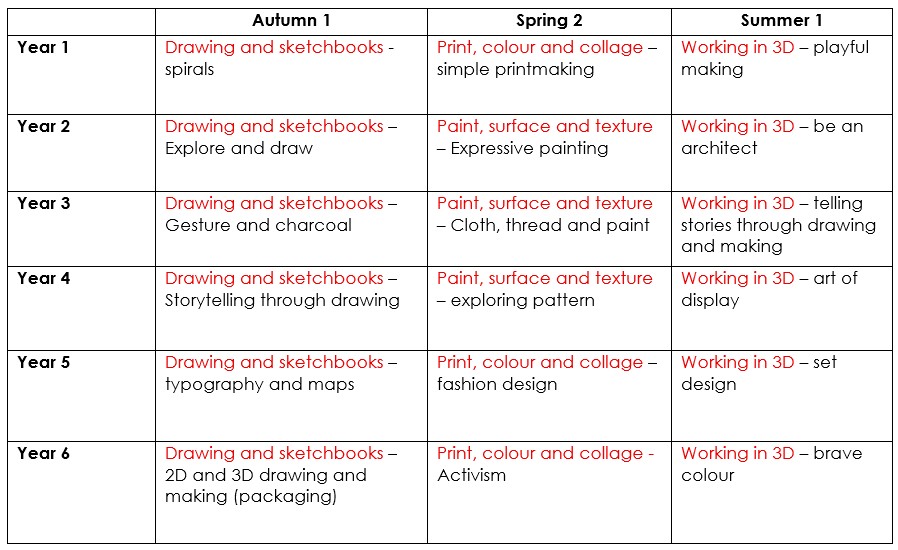
Within the federation, art is taught weekly (every other half term) in a 1-hour lesson. Children learn through a rich, contemporary and diverse curriculum facilitated by the scheme of work ‘Access Art’. The scheme involves a balance of substantive knowledge (key facts and information) and experiential knowledge (skill-based experience). Each year group will complete 3 art units within the academic year, including one Drawing and Sketchbooks unit, one Working in 3D unit and either a Paint, surface and texture or Print, colour and collage unit.
At The Growth Learning Collective, an art lesson includes activation of prior learning, links to the children’s own experiences, exposure to artists works, new skills modelled by the teacher and specific vocabulary development for children to explain their thinking. Children should be working experientially in every lesson and ideally having their own creative responses to artists work or stimuli. Children reflect on their work with ongoing discussion with their teacher and peers.
Learning is supported by a variety of educational visits. It is important to provide our children with opportunities that they may not have access to outside of school. We aim to celebrate Art with year group showcases for parents, governors and other students as well as providing competition opportunities such as entry to the Royal Academy summer show.
Our art progression map follows each unit from Year 1 - Year 6 and details prior learning, new skills introduced and key vocabulary. Children revisit knowledge and skills frequently to develop their understanding and independence.
Below is a condensed version of our Art curriculum map:
What can you do to help your child at home?
Helping your child with Art at home is all about noticing, exploring and expressing the world around them. Encourage your child to keep a sketchbook and take it with them when they go out so that they can look for things to sketch – a tree, a building, a park. Alternatively, if they see something they would like to draw, take a photo on your phone and let them sketch from it when they are home.
Many different types of art resources can be found cheaply. Paints, chalk, crayons, pens, pencils, modelling clay and much more can be found in discount shops. Alternatively, instead of buying materials, let them get creative using things around the house – for example, pasta and pulses to create pictures using glue. They can use old magazines, newspaper and packaging to make their outcomes more interesting.
Make sure to praise your child’s creations and encourage them not to get disheartened if they feel they have made ‘mistakes’. Explain that art is about being creative and experimenting with no right or wrong! You could even ‘frame’ their work using coloured paper or card and create a little gallery on the kitchen wall or in their bedroom to display their work.
There are many of free art galleries and museums in London which can support your child’s creativity and curiosity on the weekends and in the holidays such as The National Gallery, Tate Modern/ Britain and the British Museum. Encourage them to talk about what they see and share their opinions.